Sacrifice and offerings to evil
Ofrenda a la tormentaSacrifice and offerings to evil are the ritual framework through which the novel links traditional acts of appeasement to the deliberate use of human remains and the killing of infants. What begins as an offering made in hope of protection can become a way of soliciting or controlling hostile powers; the distinction between custom and crime grows increasingly difficult to ignore.
Meaning and Ritual Logic
In a conversation with Engrasi, Amaia considers the varied practices by which people sought protection from supernatural beings, or tried to enlist and dominate them. Some offerings were modest: cider, apples, or coins left at the cave of Mari, and bread or cheese placed on a rock for Basajaun. In this account, an offering is not inherently an act of evil. Its meaning changes with the power being addressed and the favor sought, turning a familiar gesture of respect into part of a more dangerous transaction.
The discussion widens from local custom to the history of witchcraft beliefs in Baztán. A century earlier, Amaia observes, belief in witches was said to be more widespread there than belief in the Holy Trinity. Historical accounts, including a claim by Salazar and Frías that the practices were not Satanism but something else, preserve the difficulty of naming the rites. Yet the novel does not leave that uncertainty as a matter of terminology: it raises the possibility that legends about abductions, the sacrifice of young women, and ritual killings of children contained a basis in actual violence. Human remains found at places associated with traditional gatherings, including the celebrated skull kept at Zugarramurdi, give the speculation a material, disturbing counterpart.
For Amaia, the suspected ritual offerings may connect the desecration of graves and the removal of human remains with the attempt to sacrifice her son. She wonders whether such acts were intended to summon Inguma, and whether the taking of a dead infant’s body could itself serve as an offering. The question shifts the concept from a private act of devotion to a pattern of crimes whose separate traces might belong to a single ritual purpose. Engrasi’s grave response, and Amaia’s recollection of the profaned family burial place and her sister’s empty grave, make the argument personal as well as investigative.
The framework also reaches beyond local folklore. Amaia notes that occult religions such as voodoo use the dead as channels of communication between worlds, and that corpses may be offered to evil. Engrasi develops the idea through accounts of lesser divine powers that required repeated sacrifices to remain active, invoking the story of Dagon’s statue falling before the Ark of the Covenant and breaking at the head and hands. She also recalls Robert Graves’s account of lesser gods withdrawing into sleep after the birth of Jesus. Within this conversation, the ancient image of dormant powers becomes a way to consider the investigators’ present fear: that something might have awakened, and that an extraordinary offering could be required to do so.
The Lesaka Group and the Ritual’s Requirements
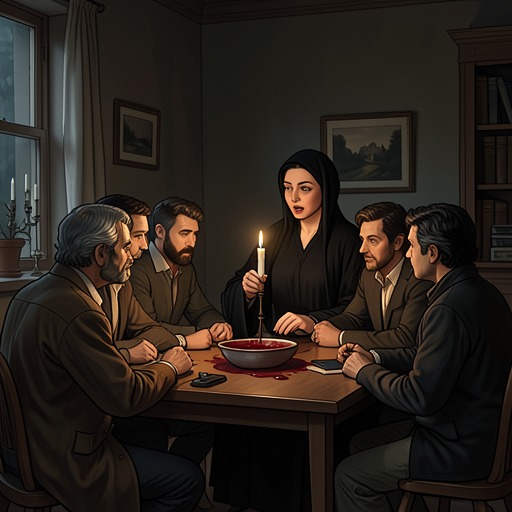
A concealed witness’s account gave the suspected rites a specific history. In 1979, a sizeable group settled in a farmhouse in Lesaka under a leader who called himself a psychologist or psychiatrist and visited regularly without living there. The group invoked ancestral beings through traditional witchcraft ceremonies, sacrificed animals—chiefly lambs and roosters—and held orgies in which members covered themselves with blood or drank it. Months after one couple had a baby girl, only days old, they offered her to the group as its supreme sacrifice; the witness described her killing as a satanic ritual offering to evil.
The group broke apart within months, its members dispersing across the country. Those implicated included lawyers, doctors, and an educator, many of them parents. The case was heard in Pamplona under investigative secrecy: it had been reported in Madrid, and the protected witness lived in hiding under police and ecclesiastical protection. The secrecy explains why Amaia initially rejected the account as impossible, having no knowledge of an open homicide case in the city; the matter had been concealed both because the alleged crime was unproven and because of the public alarm and danger that disclosure could bring.
The testimony describes the rite as governed by conditions rather than improvised violence. The victim had to be a girl, younger than two, and unbaptized. Baptism itself was understood by the group as an offering and commitment to another god, incompatible with the intended sacrifice. The child’s body, after being deprived of air in imitation of Inguma, had to be surrendered as an offering. The witness could not explain the purpose of every requirement, but said that Tabese had taught the group how the rite should be performed and what benefits it supposedly brought.
Age carried a particular ritual meaning. Jonan explained that, in many cultures, children under two were believed to move between two worlds and to see and hear what happened in both, making them suitable imagined intermediaries with spiritual realms. The witness likewise described the infant’s soul as being in transition before the second birthday; later childhood and adolescence were also represented as stages of conversion, but the death of a baby was easier for a group to explain away. These were the perpetrators’ justifications, not evidence that the claimed supernatural effects were real.
The witness further described sacrifices as organized by sex and age: when Inguma awakened, the group expected a number of victims from the same sex and age group, killed under identical circumstances, until the cycle was complete. Men were generally the most committed participants. Some women who took part fell into depression, and the group’s prescribed response was to have another child quickly; some women, the witness said, had not known what their husbands intended. In the later investigation of the Basajaun murders, Amaia revisited this language of offering and transition while studying the ritualized treatment of the girls’ bodies. The parallel made the sacrificial framework resonate beyond the Lesaka testimony, without by itself proving that the crimes shared perpetrators.
The Offering as Clue and Repeated Form
After Jonan Etxaide’s death, the word Ofrenda reached Amaia as a deliberately limited message: he had something for her, and if he could not deliver it, the person carrying the message was to make sure she remembered that word and its number. The number’s meaning is not explained here, but the instruction gives the concept a second function. Ofrenda is not only the name for an act within the group’s ritual logic; it is also a clue Jonan intended Amaia to use, linking the idea of sacrifice to the unfinished investigation without resolving what the number signifies.
The sacrificial pattern also casts a disturbing light on the Basajaun murders. Re-examining the case, Amaia recalls how the killer deprived the girls of air with a thin cord, carried their bodies to the Baztán River, tore their clothes, shaved their pubic hair, arranged their hair in two halves, and placed their open hands palms-up. A small sweet took the place of the removed hair. The gestures turned the bodies into a staged image of childhood and innocence: the girls were presented as offerings and symbolically returned to a state of purity. The bodies’ arrangement and the river’s presence recall the language of transition and offering, but the resemblance does not establish that the Lesaka group and the Basajaun killer were connected. It shows instead how the same sacrificial vocabulary can organize different layers of the investigation, making a ritual interpretation compelling while leaving its factual limits intact.
The Body as Offering
The ritual logic extends beyond the killing itself to the treatment of the child’s remains. Amaia’s investigation establishes that rites could involve dismemberment, with skulls especially prized and long bones valued as well; the Mairu-beso bones used in the desecration of the Arizkun graves give that belief a concrete trace. Teeth, nails, hair, and powder made from small bones are also named as ritual materials. Among the objects used in witchcraft, the account places the bodies of children above all others, making the corpse not incidental evidence but the offering’s most potent component.
That valuation sharpens the meaning of the age rule. The child is imagined as still between worlds, a fit intermediary precisely because the transition associated with early life has not ended; the body is then both the means of communication and what the group demands in exchange. The novel presents these ideas as the perpetrators’ ritual explanations, not as proof of supernatural power. Their force in the investigation lies in how they give distinct acts—killing, surrendering a body, and removing or using remains—a shared rationale, while exposing the human violence concealed inside the language of offering.